
Ramp logo

Ramp

Gabriel AmzallagWritten by Gabriel AmzallagUpdated Apr 30, 202616 min read
[ Who it’s for ]
01

You're past Series-B in B2B SaaS and shipping more pages stopped moving organic.

02

Your category has a clear leader and switching cost is the #1 objection on every call.

03

You sit on transactional or behavioral data you haven't turned into an SEO moat yet.

Industry
Fintech · SaaS
Stage
Series E
ICP
CFOs · Controllers
Goal
Get started for free
CMS
Sanity
CRO stack
FullStory · Hotjar · PostHog · Optimizely
[ Website score ]
94/ 100
Top decile · Fintech

Snapshot

[ Unique visitors / mo ]1.74MWorldwide
[ Traffic sources ]
Direct64%
Organic10%
Paid5%
Other20%
[ Device split ]
Desktop 69%Mobile 31%
Desktop-led
[ The rubric ]
SEO PlayDepthDistributionStrategyCoverageMoat LayerFunnelArchitectureSocial ProofDiversitySelf-ServeDepthMotion &Polish
Self-Serve Depth80/100
  • Genuine $0 free tier: not a trial
  • Pricing transparent on Free + Plus tiers
  • 20+ ungated tools at /free-tools
  • Self-education layer: help center, blog, Partner Academy
  • Miss: no interactive demo / sandbox; "See a demo" routes to a sales call, not a tour
01

Strategic plays

Back to top
AShip in a week2 plays

OwnerSEO · Design · Growth
EffortTemplate + ~2-4 hrs/variant
Funnel roleDemand capture · qualifier intent · doubles as paid LP per qualifier
Best for · B2B SaaS where buyers search with a qualifier — industry, size, role, or channel. Most useful when you have a natural referrer layer (accountants, PE/VC, integrators) for the channel variant.

What they did

Brex ships pages by industry. Mercury by stage. Gusto by size. Ramp ships ~18 pages from one template, one variant per qualifier the buyer brings — industry, size, or channel — all on the same plane.

Same template, qualifier in the H1, social proof and pricing emphasis tuned to the qualifier:

  • By industry (10 variants): technology, construction, life sciences, healthcare, retail, manufacturing, real estate, professional services, non-profits, government. Each carries vertical-specific testimonials competitors can't fake without those customers.
  • By size (4 variants): /startups, /small-business, /mid-market, /enterprise — pricing emphasis and proof tuned to each buyer's price tolerance.
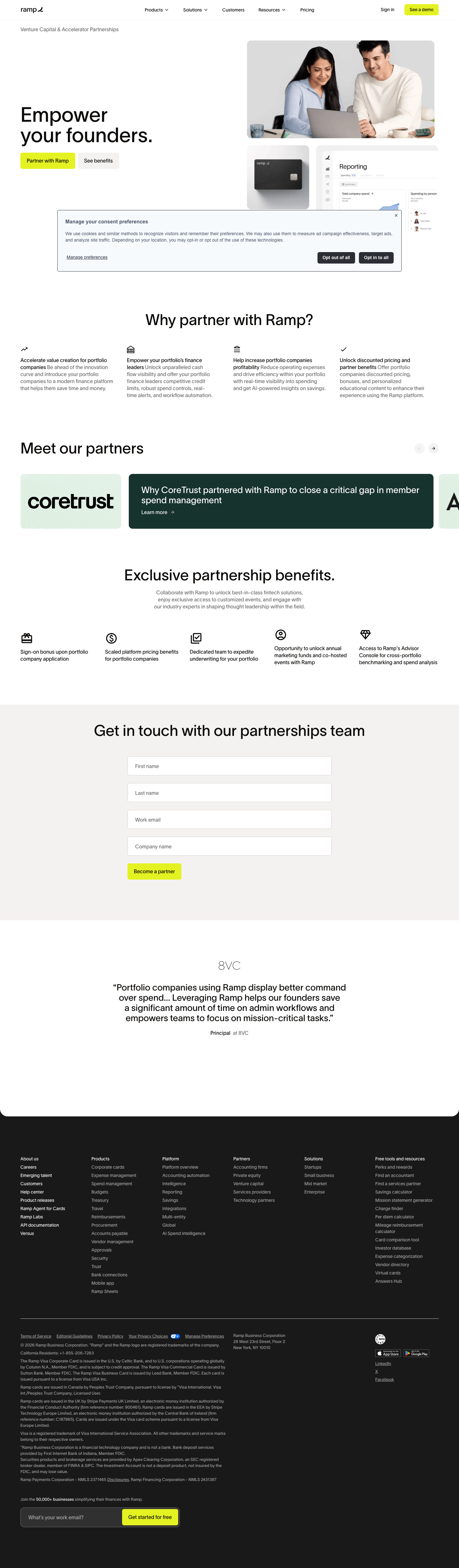
  • By channel (4 variants): /vc-partnerships, /pe-partnerships, /services-partners, accountants.ramp.com — same template aimed at the referrer instead of the buyer. Hands the prescriber a deck-style page to forward to their portfolio or clients.

~2-4 hours per variant after the template exists. The mechanic is one template; the asset is one page per qualifier.

Live pages — click to open in a new tab

Why it works

Buyers don't search the category in isolation. They search "spend management for healthcare," "spend management for small business," or send each other "this Ramp page for VC portfolio companies." A single-qualifier page lets the buyer's exact phrasing show up in the H1 — recognition lift is mechanical, not editorial.

The /vc-partnerships variant is the underrated one. PE firms and VCs aren't the buyer: they're the channel. The page doesn't pitch Ramp; it hands the VC something to forward. The fork *is* the lead gen. Outbound can't manufacture the introductions a forwarded asset does. Same template, audience flipped.

Key takeaways

  1. 01List every qualifier your buyer realistically adds: industry, size, role, channel, geography. Pick the 5-10 most-searched
  2. 02Build one template with the qualifier as the only variable: H1, hero stat, social-proof set, pricing emphasis
  3. 03Ship 10+ variants in your first sprint. ~2-4 hours per variant after the template exists
  4. 04If you have a natural channel layer (accountants, agencies, PE/VC, integrators), ship one variant aimed at the referrer. Same template, audience flipped
  5. 05Footer-link a hub on every variant for crawl equity

BShip in a month1 play

CShip in a year3 plays

02

Inside Ramp's homepage

Back to top
[ Homepage score ]
63/ 100
ramp.com
HeroConversionCopywritingDesign & UXValuepropositionTrust &credibility
Hero42/100
  • Clarify who it's for and why.
  • Quantify outcomes; replace vague "blink of AI".
  • State a clear, unique differentiator upfront.

Ramp landing page
Scroll to explore
ramp.com
Verdict

Design & UX leads at 92, but the value prop falls to 55 because the AI-agent narrative dilutes the savings promise. Hero (42) is the weakest axis — no quantified outcome and no clear ICP.

What's dragging it down
  • AI-agent grid reads as vanity metrics and competes with the savings angle
  • Trust block sits below the fold and only scores 29/100 in our rubric
  • Two CTAs (Get started / See a demo) without clear hierarchy on a busy hero
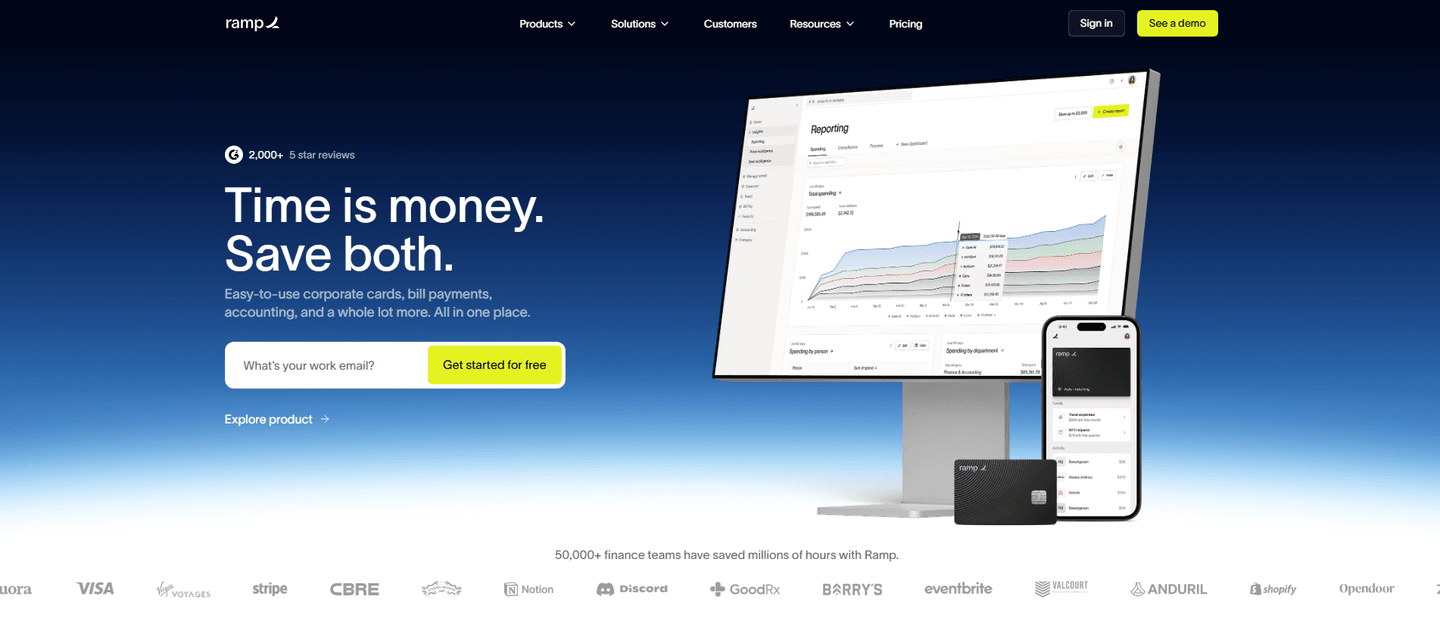
A

Headlining the thesis

Steal this ifYour category has a dominant cliché your competitors lean on ("Time is money", "Move fast and break things") and inverting it gives you a free positioning move your buyers can repeat to their CFO without notes.
HERO
  1. 1G2 badge (2,000+ 5 star reviews) positioned above the headline establishes trust before the value prop lands
  2. 2Massive logo bar (Visa, Stripe, CBRE, Notion, Discord, GoodRx, Shopify, Anduril) spanning the full width signals enterprise scale
  3. 3Real reporting dashboard showing Spend by payee and Spend by department charts proves the financial analytics product
  4. 450,000+ finance teams have saved millions of hours with Ramp combines customer count with outcome promise

Key takeaways

  1. G2 badge (2,000+ 5 star reviews) positioned above the headline establishes trust before the value prop lands
  2. Massive logo bar (Visa, Stripe, CBRE, Notion, Discord, GoodRx, Shopify, Anduril) spanning the full width signals enterprise scale
  3. Real reporting dashboard showing Spend by payee and Spend by department charts proves the financial analytics product
  4. 50,000+ finance teams have saved millions of hours with Ramp combines customer count with outcome promise
B

Substantiating the value claim

Steal this ifYour value prop is one big qualitative claim with no hard numbers — your visitor reads it and thinks "yeah, but how much."
VALUE PROPOSITION
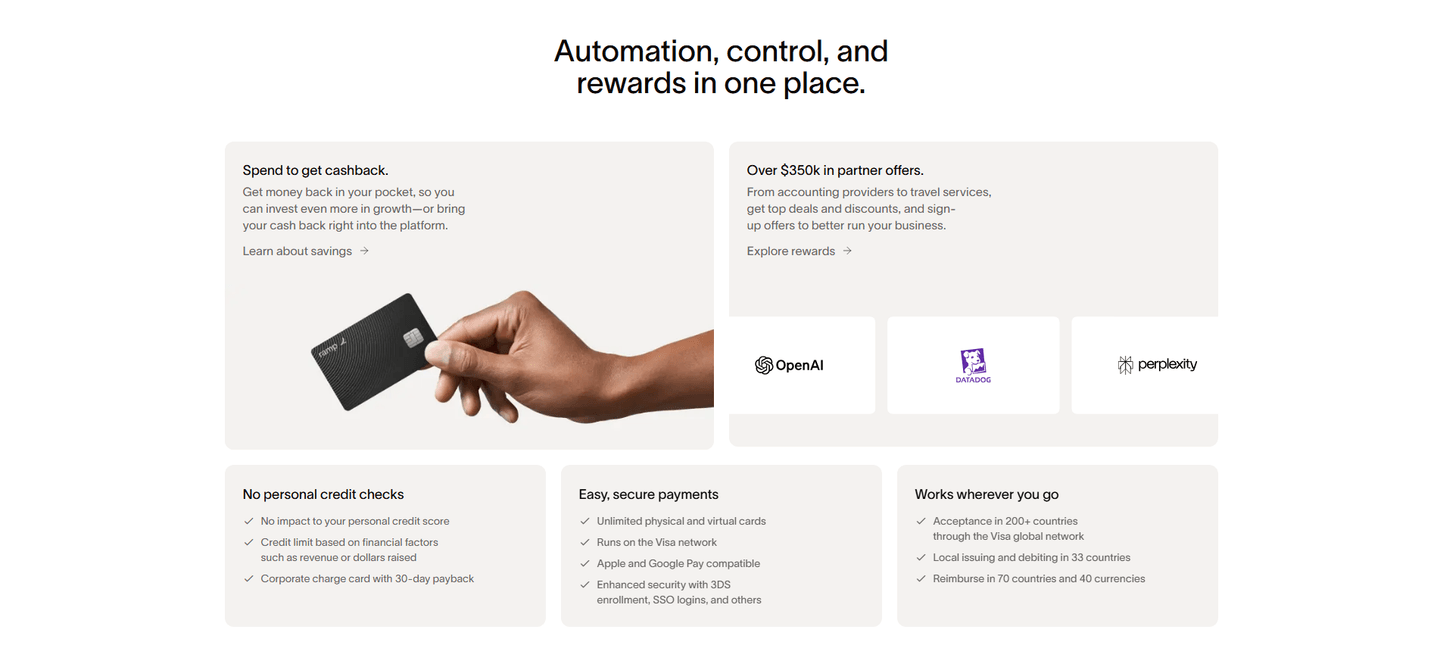
  1. 1Quantified partner value (Over $350k in partner offers) gives a concrete dollar reason to sign up beyond the core product
  2. 2Multiple distinct value props (cashback, global coverage, no credit checks) appeal to different buyer concerns simultaneously
  3. 3Learn about savings and Explore rewards deep-dive links let interested visitors self-qualify without cluttering the section
  4. 4Partner logos (OpenAI, Datadog, Perplexity) signal relevance to modern tech companies choosing a corporate card
  5. 5Specific numbers (200+ countries, 30-day payback) build trust through precision rather than vague claims

Key takeaways

  1. Quantified partner value (Over $350k in partner offers) gives a concrete dollar reason to sign up beyond the core product
  2. Multiple distinct value props (cashback, global coverage, no credit checks) appeal to different buyer concerns simultaneously
  3. Learn about savings and Explore rewards deep-dive links let interested visitors self-qualify without cluttering the section
  4. Partner logos (OpenAI, Datadog, Perplexity) signal relevance to modern tech companies choosing a corporate card
  5. Specific numbers (200+ countries, 30-day payback) build trust through precision rather than vague claims
D

Showing product, not promising it


04

Steal this

Back to top

One row per play. Three questions per row that decide whether you ship it. Drop the table into Notion, ask in your next standup, see which plays survive contact with your roadmap.

Play01
Ship a landing page for every qualifier your buyer brings
OwnerSEO
EffortWeek
    Three questions
  1. 01When our buyer types our category into Google, what qualifier do they add — industry, size, role, or who referred them?
  2. 02Could one template — H1, hero stat, social proof, pricing emphasis — service every qualifier with a 2-4 hour rewrite?
  3. 03Do we have a natural channel layer (accountants, agencies, integrators, PE/VCs) we could ship a forwarding-asset variant for, using the same template?
Play02
Productize the switching motion
OwnerConversion
EffortWeek
    Three questions
  1. 01What's our current answer to 'I already use [competitor]' — a comparison chart, or a numbered process with a named human?
  2. 02Could we put a named onboarding specialist on the page instead of a chatbot or a generic 'we'll help you' line?
  3. 03Which 3 customers can we name on a /switch page — and will they let us print the previous tool by name?
Play03
Build a free-tools ecosystem at scale
OwnerSEO
EffortMonth
    Three questions
  1. 01What 15 questions does our ICP Google before they buy — and which of those does no one own a tool for?
  2. 02Are our existing tools gated at the input or the output? If input, what's the lift to flip them?
  3. 03Which of our tools would a sales rep actually drop into a cold email instead of a generic deck?
Play04
Turn proprietary data into an SEO moat
OwnerSEO
EffortYear
    Three questions
  1. 01What aggregated data do we sit on that we've never published — transactions, usage, integrations, churn signals?
  2. 02If we published it as 'fastest-growing X' or 'most-adopted Y', could a competitor refute the methodology?
  3. 03Is there a path to bridge the public asset to a real product feature using the same dataset, the way Ramp Rate bridges to Price Intelligence?
Play05
Run an Economics Lab as an authority engine
OwnerPMM
EffortYear
    Three questions
  1. 01What leading-indicator data do only we have — and would a Federal Reserve economist or NYT reporter actually want to cite it?
  2. 02Can we hire credibility (in-house economist, ~$200-400K) or rent it (analyst plus a named contracted byline, ~$80K/yr)?
  3. 03Who are the 5-10 named journalists we'd pitch the first flagship report to — and what's the headline number that earns citation #1?
Play06
Turn partners into a ranked public directory
OwnerSales
EffortYear
    Three questions
  1. 01Who's our prescriber layer — and is our current 'partners' page a logo wall or a public, ranked, searchable directory?
  2. 02What's the regulatory or career carrot we could attach to the higher tiers (CPE credits, certifications, qualified leads)?
  3. 03If we made the ranking semi-opaque, would our partners actually compete to climb it — or would the algo just get gamed?
Gabriel Amzallag

Curated by

Gabriel Amzallag , Founder, LPA

5 years CRO + SEO at Qonto (2021–2025). After advising 15+ SaaS on their websites (Payfit, Pigment…), the same patterns kept breaking — so I decided to build the source of truth on what works on the web: the intelligence layer every tool, builder, and team uses to ship sites that perform.