Hand-picked by our team, updated every week. Each page runs through our AI conversion agent so you can see exactly what works — and why.
Every landing page is scored section by section across 60+ conversion angles. Copy the pattern stack, not the design. See what converts and why.
Hand-picked across SaaS, fintech, ecommerce, and more. Analyzed by our AI conversion agent across 13 section types. Every entry earns its spot.
Found a page you admire? Run yours through the same scoring engine. See where you stand on the same 60+ angles, and what to fix first.
There are dozens of landing page galleries out there. Dribbble, Awwwards, Landingfolio, Lapa Ninja. They all do the same thing: collect screenshots of pages that look good.
That’s the problem. They optimize for design. Gradients, animations, whitespace, visual polish. Looks great in a portfolio. But looking good and converting visitors into customers are two different skills.
We kept seeing the same pattern: a founder copies an award-winning layout, launches, and gets a 1.2% conversion rate. The page looks like Stripe but converts like a blank page. Why? Because design galleries never show you the conversion mechanics behind the page. The copy structure. The trust signal placement. The CTA friction points. The section-by-section logic that turns a visitor into a customer.
We browse the web every week to find landing pages that stand apart. We keep only the ones that get the fundamentals right. Then we run each page through our landing page analyzer, which scores every section on 60+ conversion angles and explains why it works, with evidence pulled directly from the page.
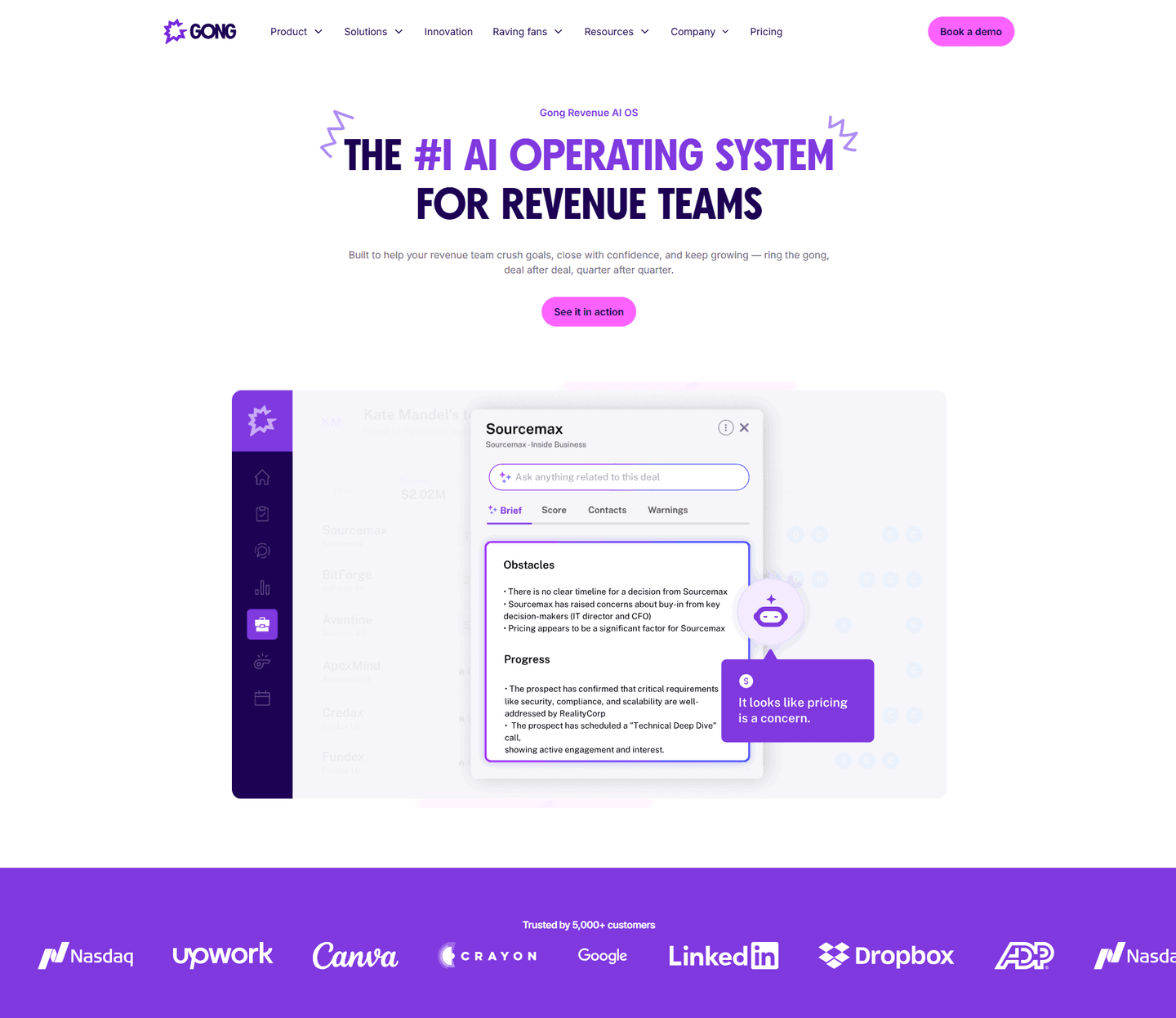
Every gallery site can tell you that Gong has a nice homepage. We can tell you it scored 100/100 on its hero section because it combines a differentiated headline, social proof above the fold, a product screenshot, a risk reducer near the CTA, and strong visual hierarchy. Five conversion angles in one section. That’s not an opinion, it’s a scored breakdown from our AI agent.
We break down landing pages into 13 section types, each scored independently. A screenshot gives you inspiration. A scored breakdown gives you a checklist.
This is getting worse, not better. AI tools made it easy to ship a page in an afternoon. The tradeoff: every homepage starts to look identical. Same hero structure, same “trusted by” logo bar, same vague headline that could describe any product. No personality. No tone of voice. No reason to trust this company over the next one.
The high-converting landing page examples in our gallery break that pattern. They have a point of view. Their copy speaks to a specific person with a specific problem. Their design choices serve the conversion goal, not the designer’s portfolio.
That’s what we look for when we select pages. Not “does this look modern?” but “would this make someone pull out their credit card?”
These patterns come from real data, not opinions. Run the same analysis on your own page to see how you compare.
| Pattern | What we found | Stat |
|---|---|---|
| Almost nobody uses urgency in their CTAs | Only 10% of the top-scoring CTA sections use countdown timers, limited spots, or FOMO tactics. The other 90% focus on reducing friction: "No credit card required," "1-minute setup," clear microcopy under the button. | 10% |
| The "one CTA" rule is a myth | 70% of top-scoring CTA sections include a secondary path, like "Watch a demo" or "Talk to sales" alongside the primary action. Giving hesitant visitors an alternative converts better than forcing a single choice. | 70% |
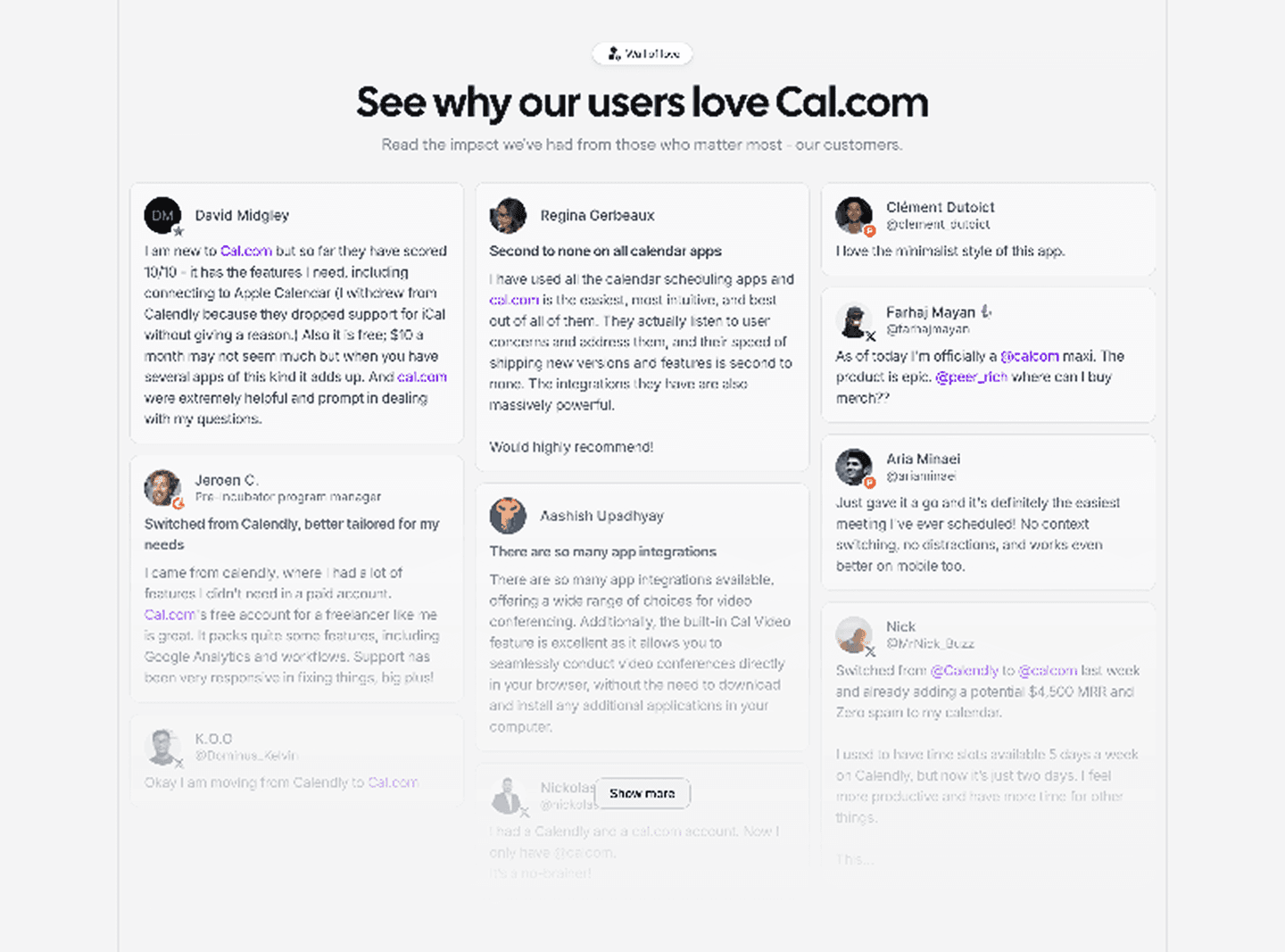
| Who said it matters more than what they said | In testimonial sections, role and title diversity appears in 100% of top scorers. Quantified results ("saved 40 hours/month") only appear in 50%. Broader role diversity builds broader trust. | 100% |
| Security badges are overrated for trust | Only 30% of top trust sections display SOC2, GDPR, or ISO badges. Meanwhile, 100% use quantified proof: "10,000+ teams," "4.8/5 on G2," "99.9% uptime." Numbers beat certification logos. | 30% |
The biggest takeaway: the gap between high-scoring and low-scoring pages is rarely about design quality. It’s about how many conversion patterns they stack in each section. Best-in-class pages layer 4-5 patterns where others use 1-2.
Every landing page is broken down into scored sections. Pick a section type to see what top companies do differently.

First impression above the fold. Value proposition, product visuals, social proof placement. Scored across 6 conversion patterns.
Browse hero sections
Friction reduction, microcopy, secondary paths. See how top SaaS pages structure their call-to-action sections to drive clicks.
Browse CTA examples
Logos, quotes, case studies, video testimonials. Browse the patterns that build trust and reduce hesitation.
Browse testimonialsPaste your URL. Get a scored analysis across 13 section types with specific fixes. Takes 2 minutes.
Everything you need to know about our scored landing page gallery, based on data from 290+ companies.
We define "best" as pages that convert, not pages that win design awards. Three landing pages that score consistently high across our AI agent's 60+ conversion angles: Gong (gong.io) scored 100/100 on its hero section. The headline differentiates immediately, social proof sits above the fold with customer logos, and the product UI is visible before you scroll. Ahrefs (ahrefs.com) also scored 100/100 on hero. Ahrefs leads with a clear value proposition for SEO professionals, shows the tool interface in the hero, and uses quantified proof. Whatfix (whatfix.com) is strong across multiple sections with a differentiated position in digital adoption and concrete outcomes. These three share a pattern: they prioritize clarity over creativity.
We browse the web every week to identify websites that stand apart, from companies with strong conversion reputations across SaaS, ecommerce, fintech, and other industries. We keep only the ones that get the fundamentals right, then run each page through our AI conversion agent. The agent scores every section individually on specific conversion angles: value proposition clarity, friction reduction, social proof placement, and 60+ more. If the fundamentals aren't there, the page doesn't make the cut. We add 7 new websites every week.
The agent evaluates 13 section types: hero, CTA, pricing, testimonials, trust signals, features, FAQ, and 6 more. Each section type has its own conversion angles. Hero sections are scored on value proposition clarity, differentiation, social proof placement, product visuals, and risk reducers. CTA sections on friction reduction, microcopy quality, urgency signals, and secondary paths. There are 60+ angles total. For each angle, the agent provides evidence pulled from the actual page: the specific headline, the exact badge, the button copy.
Our data confirms it. Some of the flashiest pages in our gallery score poorly because the hero buries the value proposition under an animation, or the CTA competes with 4 other buttons, or trust signals are nowhere near the fold. Meanwhile, pages with plain backgrounds, standard fonts, and zero animations score in the top tier because they nail the conversion fundamentals. "Best" in our gallery means "brings clients," not "wins design awards."
Design galleries filter for aesthetics. We filter for conversion. Every page here has been scored by our AI conversion agent, section by section, on 60+ conversion angles. You don't just see a screenshot. You see why the page works, backed by data. We also break each page down into 13 section types so you can compare how different companies handle their hero, CTA, or pricing section specifically.
You can. Paste your URL into our analyzer and get a full scored audit in 2 minutes, with section-by-section scores compared against 1,248 benchmarked sections from 290+ companies. The free plan includes 3 analyses per month.
Every week. We add 7 new websites and rescore existing ones. The gallery currently includes 239 landing pages from 290+ companies. Each update recalculates best-in-class thresholds, so the bar keeps rising.