Marketing buyers arrive already skeptical of marketing. They know the playbook. The strongest marketing website design patterns in this benchmark do four things consistently:
53.6/100
Avg. page score
What strong marketing pages do before the buyer clicks
Lead with a specific outcome, not a category label. Pair a concrete benefit with quantified proof so the visitor knows what changes if they sign up.
Show the product working, not just described. Pages that include real UI, workflow diagrams, or dashboards outperform those that rely on stock imagery or abstract promises.
Use visual hierarchy to move the eye from promise to proof to action without friction. The strongest pages organize information so nothing competes with the primary message.
Back claims with third-party proof early. Review badges and external validation establish credibility before the visitor is asked to commit, reducing the "trust tax" marketing tools face in a crowded market.
6 best marketing homepages analyzed in detail
Each company below is paired with its strongest section and scored across 60+ conversion criteria. See what they get right, and what you can borrow.
01
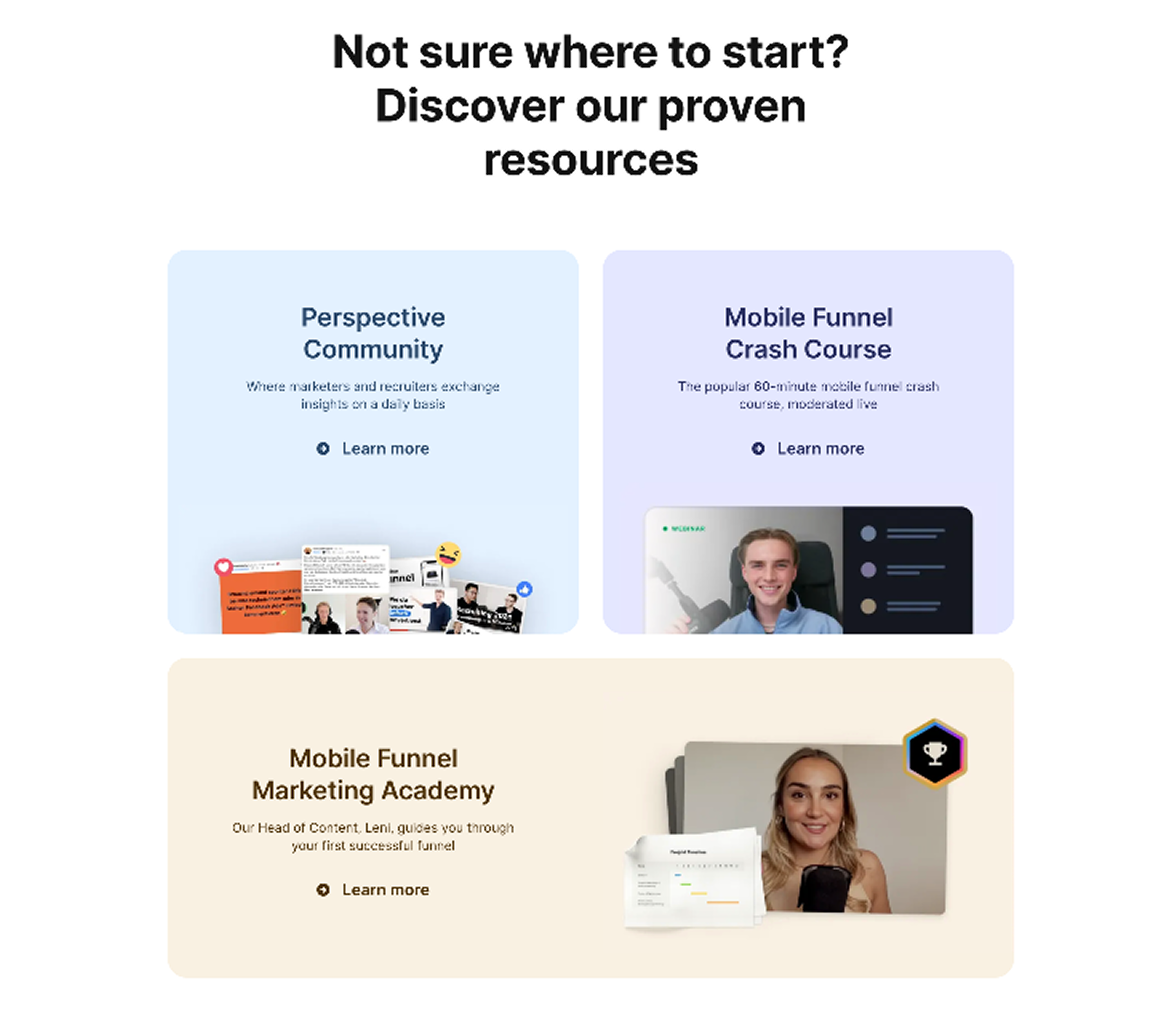
Perspective— Marketing platform with layered educational resources and human proof.
“Perspective builds trust through resource depth: community access, a crash course, and an academy create three entry points for different buyer readiness levels. A named team member humanizes the brand, and the wider bottom card uses visual weight to steer attention toward the highest-value action. The resources section scored 60, showing that breadth of educational content can differentiate a marketing platform even when the core product is not shown.”
What makes this page stand out
"Easily create mobile-first, interactive, and personalized lead gen and sales funnels with market-leading conversion rates in just 30 minutes" packs multiple differentiators into one sentence: mobile-first, interactive, personalized, fast time-to-value.
"No design or coding skills required" removes the primary adoption barrier for the target audience (SMBs and agencies).
"Create free funnel in 30 min" CTA is brilliantly specific — the time commitment sets concrete expectations and makes the action feel achievable.
Dual review scores (G2 4.9, OMG 4.8) provide exceptionally high ratings that build immediate trust, complemented by "1k+ growth community" showing ecosystem engagement.
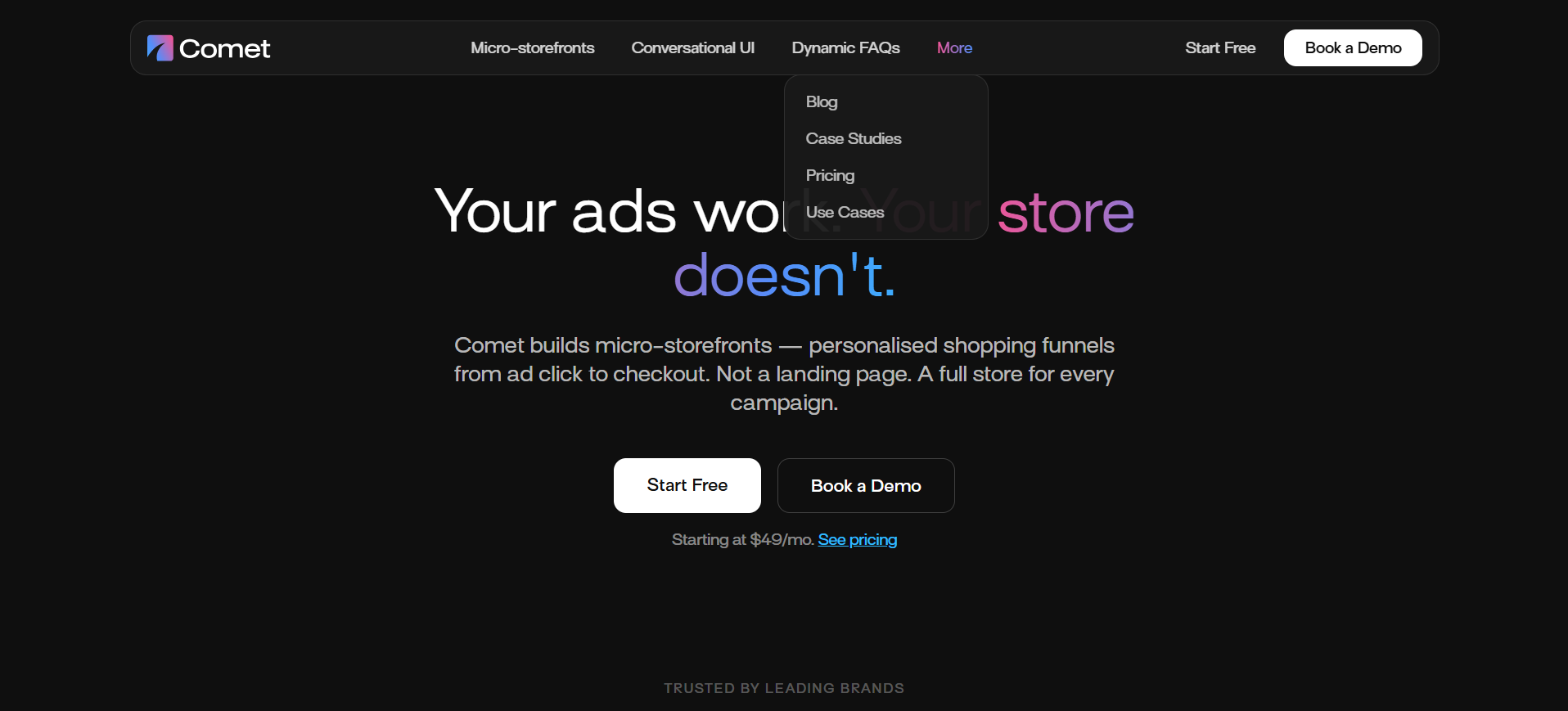
“Comet Rocks earns a top-scoring navbar with product feature tabs covering Micro-storefronts, Conversational UI, and Dynamic FAQs. Dual CTAs (Start Free and Book Demo) let visitors self-select by intent, and pricing visibility in the dropdown removes a common friction point. The navigation does the positioning work that most marketing pages leave to the hero alone.”
What makes this page stand out
"Micro-storefronts" concept creates a new product category — not landing pages, not full stores, but personalized shopping funnels
Price anchoring ($49/mo starting) in the hero removes a major objection early and signals accessibility
Brand logos (NARS, Supercilium, Qure) provide social proof from recognizable beauty/lifestyle brands
"From ad click to checkout" clearly maps the user journey, making the value proposition immediately tangible
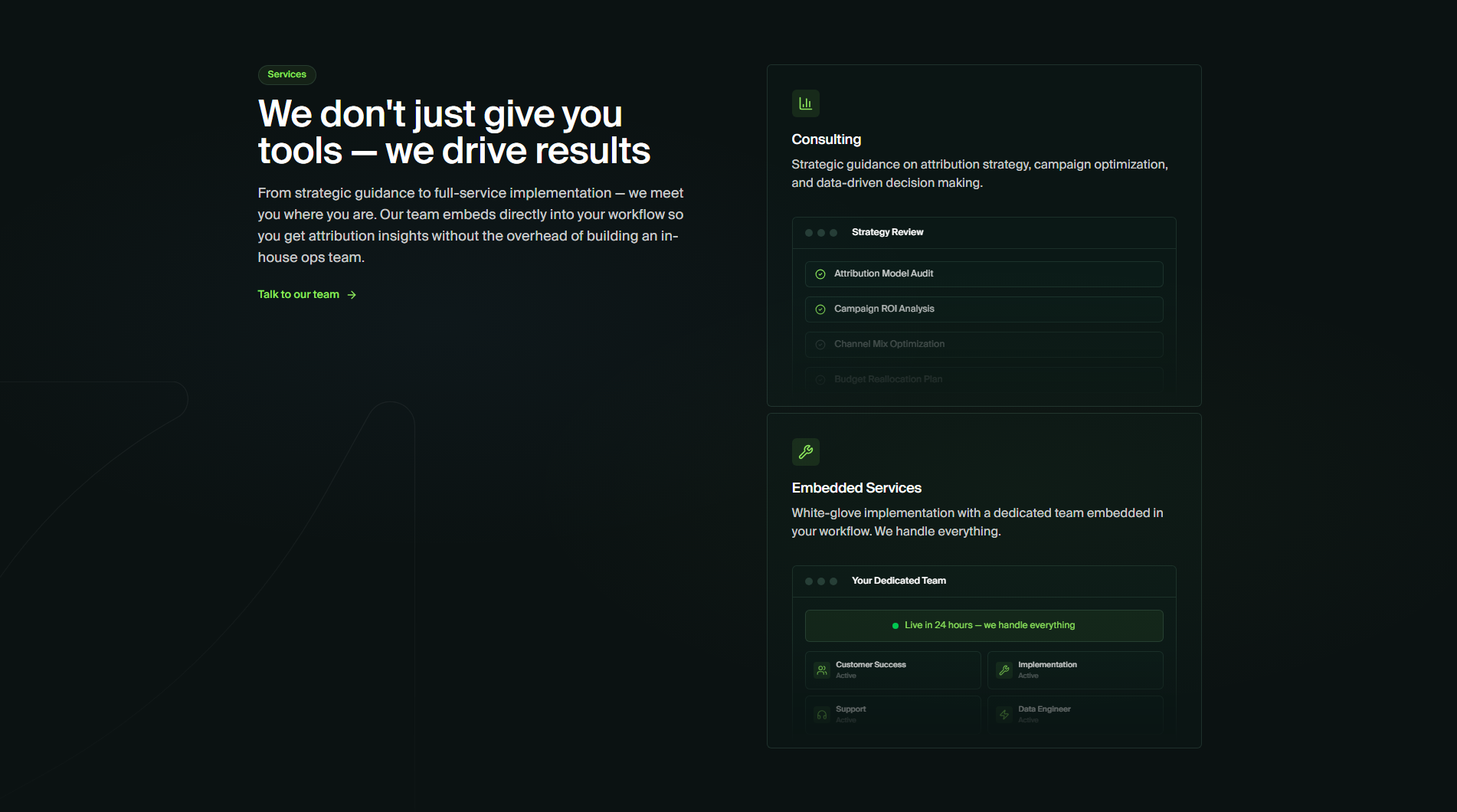
“Rampmetrics scores 67 on its value proposition by drawing a clear line between Consulting and Embedded Services. The copy addresses the cost objection head-on with "without the overhead of an in-house ops team," and accordion UI lets evaluators drill into service details without leaving the page. This is a strong model for marketing agencies and platforms with tiered offerings.”
What makes this page stand out
The detailed breakdown of homegrown attribution weaknesses (data gaps, cross-channel blind spots, maintenance burden, stale models) validates the buyer's existing frustration with specific evidence
Clear differentiation through automated multi-touch attribution eliminates the manual data wrangling that makes homegrown solutions unsustainable as marketing channels multiply
The "single source of truth" promise addresses the organizational pain of marketing and sales teams arguing over which channels actually drive revenue
Real-time attribution visibility transforms marketing from a monthly reporting exercise into a continuous optimization loop — enabling faster budget reallocation decisions
Section we love
·Value Proposition
1Clear distinction between Consulting (strategic guidance) and Embedded Services (hands-on implementation) lets buyers self-select
2Without the overhead of building an in-house ops team directly addresses the cost and hiring objection
3Accordion UI with service details (Strategy Review, Attribution Model Audit, Campaign ROA Analysis) adds specificity without overwhelming
04
ZoomInfo— B2B data platform with review-count authority in the hero.
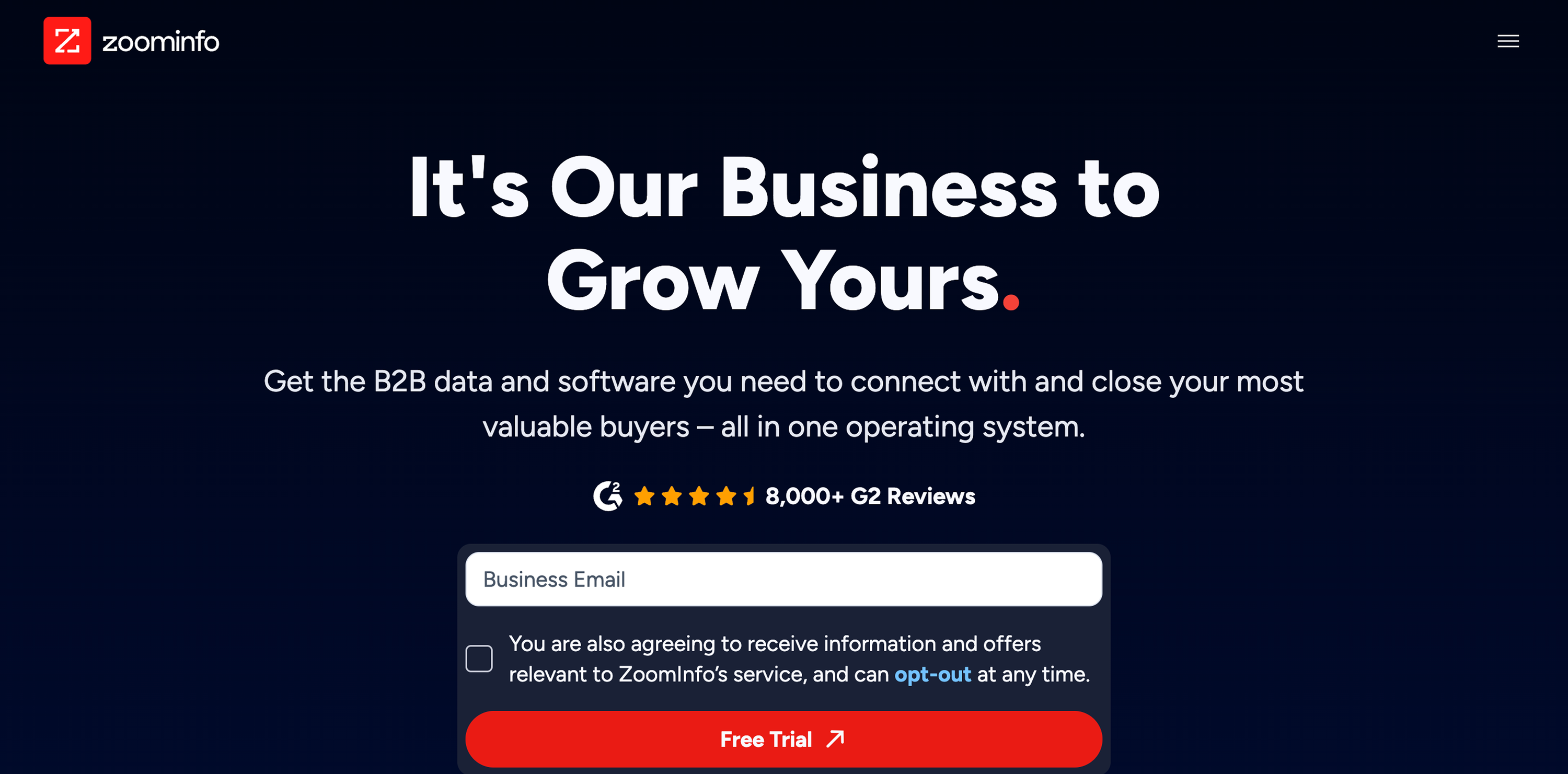
“ZoomInfo leads with a G2 badge citing 8,000+ reviews and a red Free Trial button that creates immediate visual contrast. The "B2B data and software" positioning is blunt and effective: it tells the buyer exactly what category they are in. The hero scored 56, lifted by the combination of social proof density and a single, clear action.”
What makes this page stand out
The "#1 GTM Platform" claim in the page title is bold category ownership — supported by G2 Grid leadership and Forrester Wave recognition
Social proof is exceptionally well-quantified: 35,000+ customers, 54% increase in customer engagement (Seismic), 43% more likely qualified pipeline, 4x pipeline growth, 40% increase in closed-won deals
The role-based solution navigation (Sales Development, Account Executive, Account Management, RevOps, Demand Generation) shows deep ICP understanding and personalized messaging paths
Named customer testimonials with specific titles and companies (Seismic CBO, Spekit RevOps Manager) add credibility through executive-level social proof
Section we love
·Hero
1G2 badge with 8,000+ reviews and 5 stars provides massive third-party validation
2Red Free Trial button on dark background creates the highest possible contrast for the CTA
3B2B data and software subtext clearly positions ZoomInfo as a sales intelligence platform
4Grow Yours headline combined with connect and close your most valuable buyers promises revenue outcomes
05
Beamly— No-code marketing builder with a top-scoring how-it-works section.
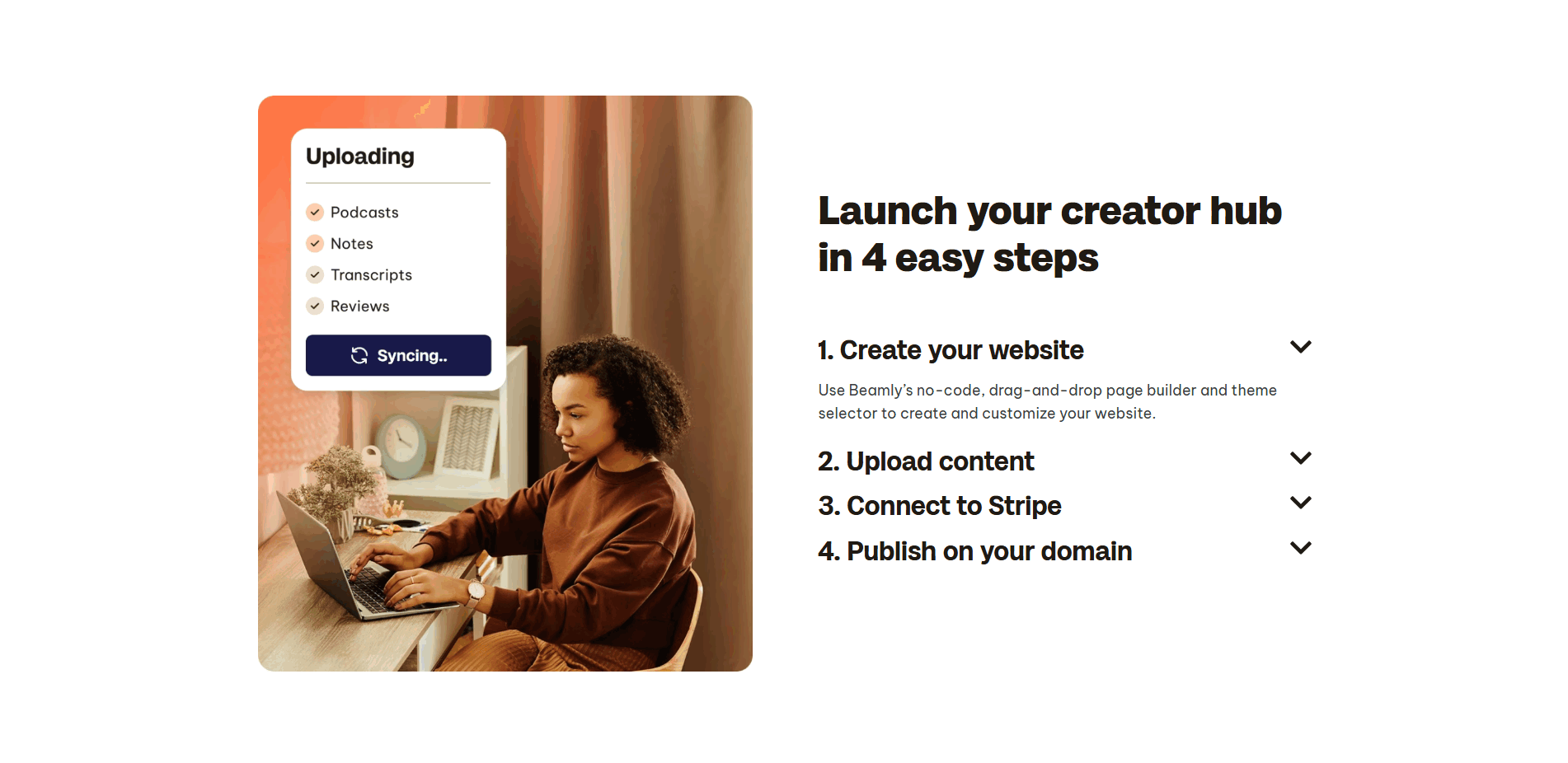
“Beamly earns a top-scoring how-it-works score with "Four easy steps" framing that turns a potentially complex workflow into a scannable sequence. No-code drag-and-drop messaging reduces effort perception, and an upload UI mockup shows the product in action before the visitor has to commit. This is how marketing tools should explain themselves to non-technical buyers.”
What makes this page stand out
Key features and capabilities are highlighted upfront: creator discovery, campaign management, content approval workflows, and performance analytics — the full brand-creator collaboration lifecycle
The product explanation makes the workflow tangible: brands find creators, brief them, review content, approve deliverables, and measure results — all within one platform
Creator economy positioning taps into a massive growth market where brands are shifting budget from traditional advertising to influencer and creator partnerships at an accelerating rate
The brand-side focus (helping brands manage creator relationships) rather than creator-side (helping creators monetize) creates a clearer monetization model: brands have bigger budgets than individual creators
Section we love
·How It WorksBest in class
1Four easy steps headline frames the process as simple and achievable
2No-code drag-and-drop description in step 1 reduces perceived technical effort
3Upload UI mockup on the left shows the product in action during content upload
4Steps cover the full journey from creation to publishing on your own domain
06
Whatagraph— Marketing data workflows shown visually with dual-intent CTAs.
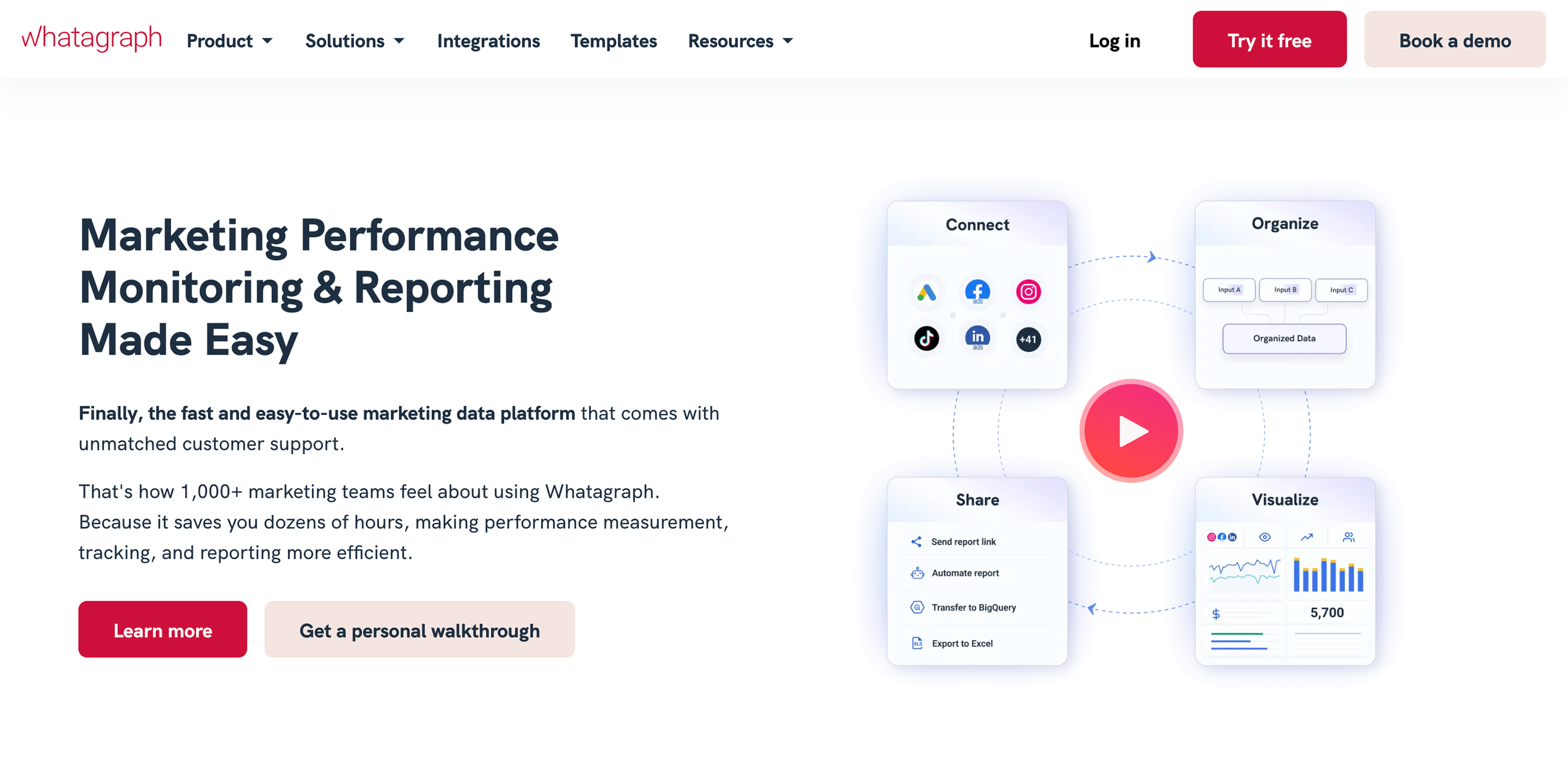
“Whatagraph pairs dual CTAs (Learn more and Get walkthrough) with a product workflow diagram that maps Connect, Organize, Share, and Visualize stages. The 1,000+ marketing teams claim and integration icons for Google Ads and Facebook make the platform feel immediately familiar. The hero scored 44 but is strengthened by the workflow visual doing the work that copy alone cannot.”
What makes this page stand out
The value proposition flow (connects, cleans, delivers instant insights — all in one place) addresses the three biggest pain points in marketing reporting: data fragmentation, data quality, and time to insight
Social proof is agency-focused and ROI-driven: 1,000+ agencies and brands, with case studies showing 100 hours saved/month, 65% cost savings, and 63 hours/month saved — all quantified time/money metrics
The "AI workflow" positioning shows modern market awareness, but the core promise remains simplicity and ease of use — a smart balance between innovation and accessibility
"Designed for marketers, not data teams" is an implicit competitive positioning against tools like Looker, Tableau, or Power BI that require technical expertise
Section we love
·Hero
1Dual CTAs (Learn more and Get a personal walkthrough) let visitors self-serve or get guided tour
2Social proof (1000+ marketing teams) with specific benefit (saves you dozens of hours) in body text
3Product workflow diagram (Connect, Organize, Share, Visualize) shows the full data pipeline at a glance
4Clear product category (fast and easy-to-use marketing data platform) stated in bold subtext
See how your page compares to the 53.6 marketing average
Run a section-by-section diagnostic on your marketing page and get prioritized fixes, then see how you stack up against these marketing website examples.
Design patterns across high-performing marketing pages
Across 84 marketing pages reviewed, the strongest pages earn attention by proving their value before asking for commitment. Something marketing buyers demand because they already know the tricks.
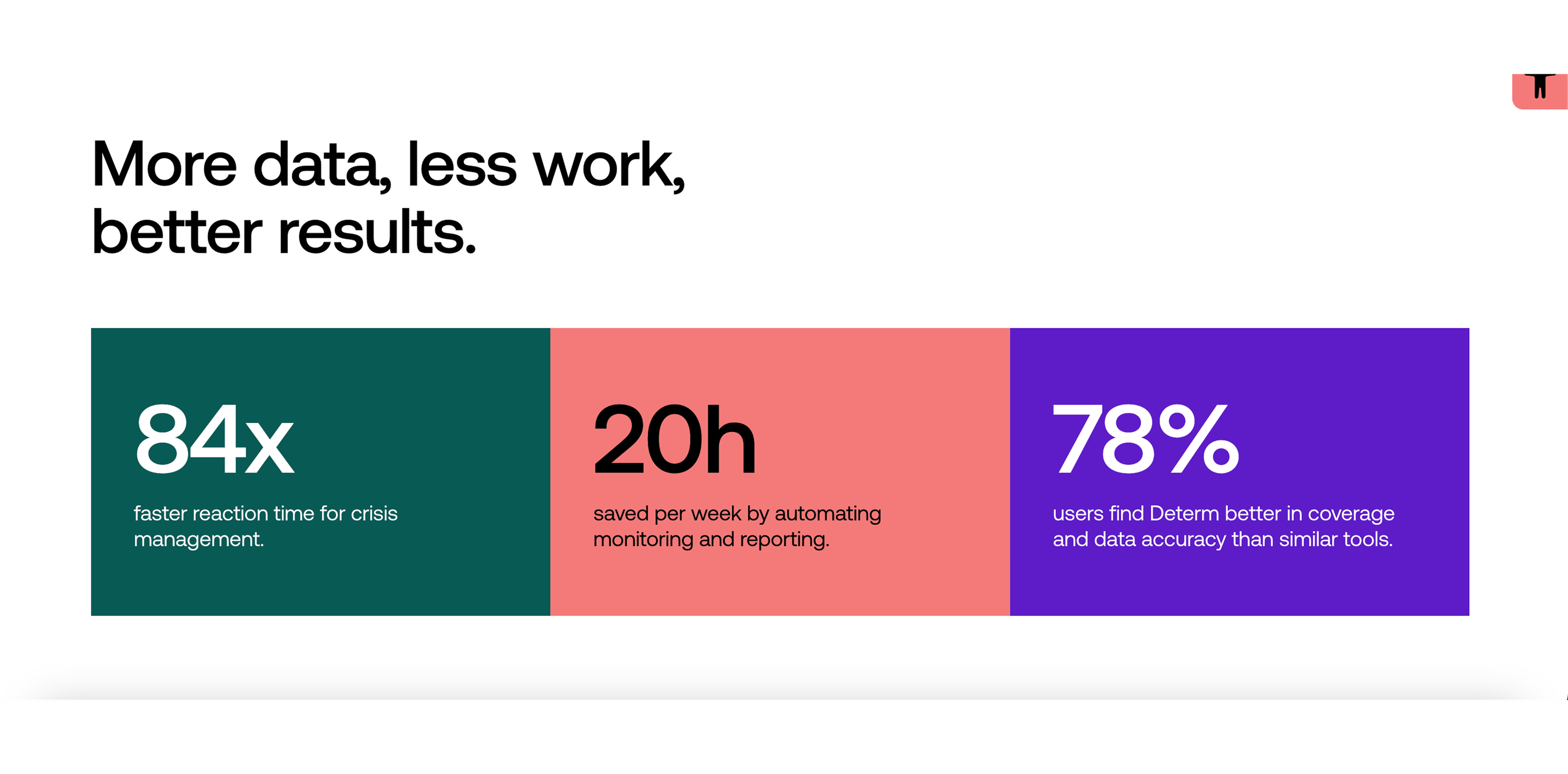
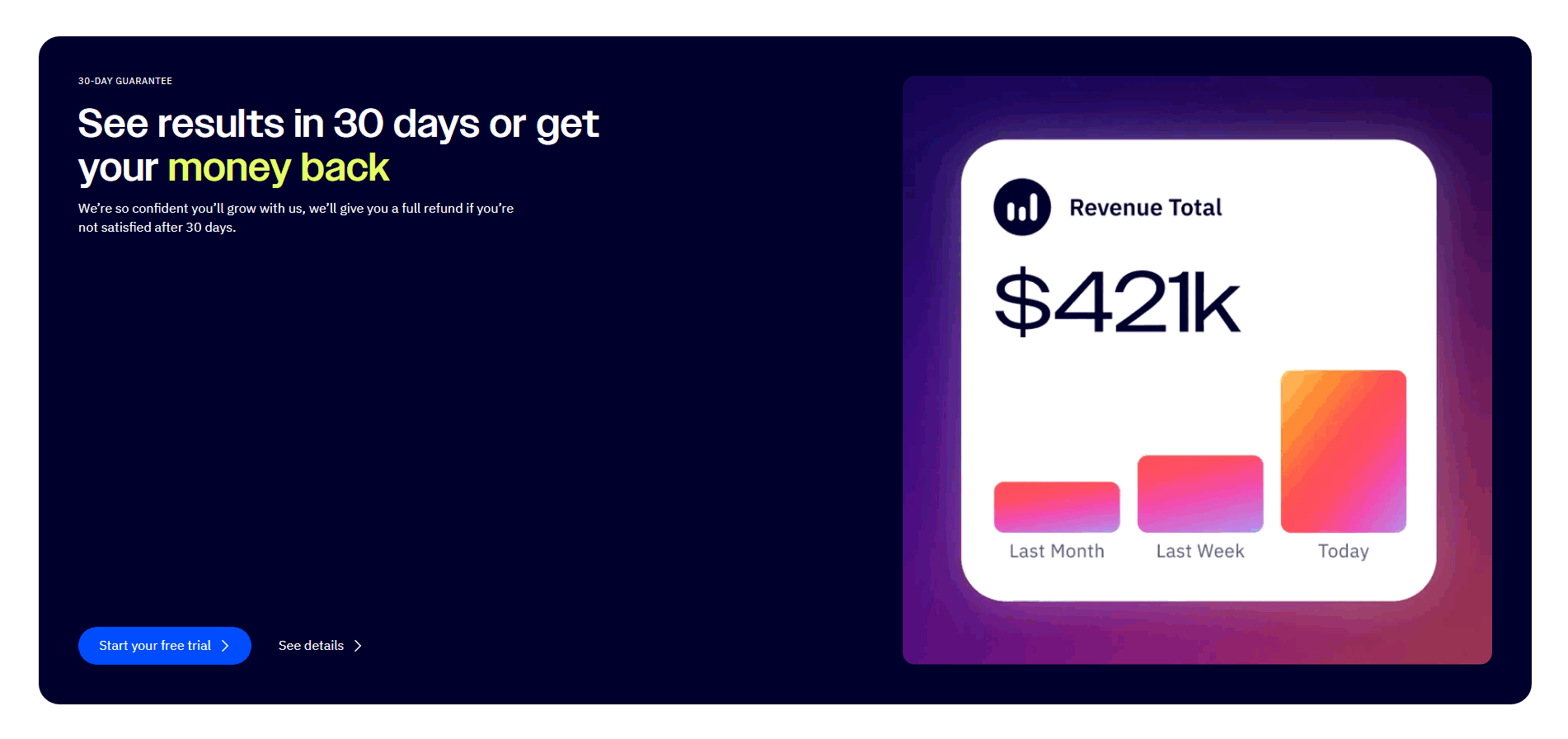
The clearest marketing website examples treat visual hierarchy as a strategic choice, not a design preference. The best pages structure information so the eye moves from a specific promise to verifiable proof to a single clear action. Design patterns from Determ (84x faster reaction time and 20 hours saved per week) and ActiveCampaign (30-day money-back guarantee alongside a revenue dashboard showing $421k) show how quantified proof and risk reducers work together. Explore best landing page examples to see how other industries handle similar trust friction.
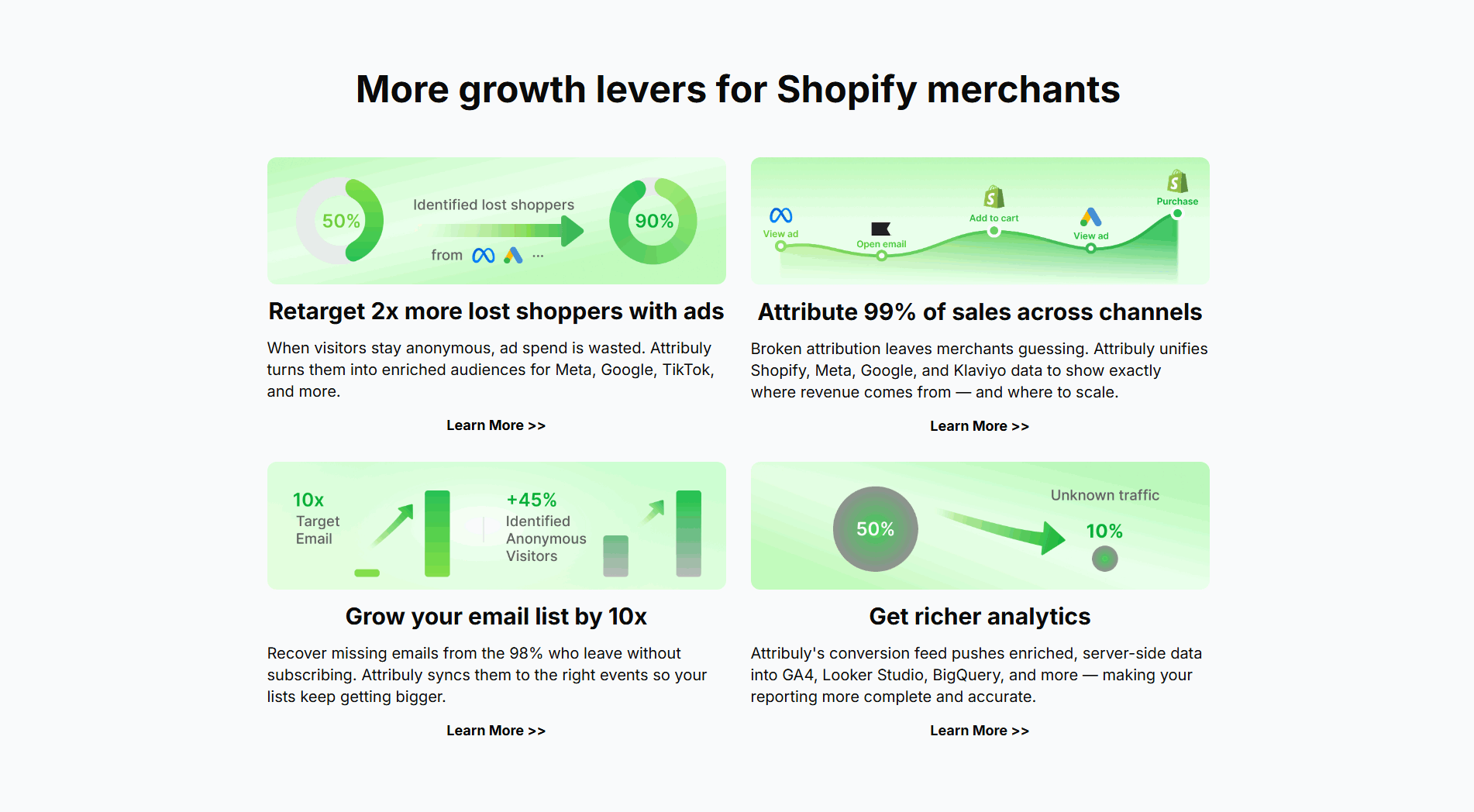
1Each of four growth levers pairs a specific quantified outcome with a clear mechanism explanation (e.g. retarget 2x via enriched audiences)
2Visual charts and funnel diagrams adjacent to each proposition make abstract analytics concepts immediately graspable
3Learn More links on every card give prospects a natural next step without leaving the value prop context
4Shopify-specific framing narrows the audience instantly signaling this is purpose-built not generic
Reviewed design-pattern pick from Attribuly’s value proposition section.
What I love about this section
Each of four growth levers pairs a specific quantified outcome with a clear mechanism explanation (e.g. retarget 2x via enriched audiences)
Visual charts and funnel diagrams adjacent to each proposition make abstract analytics concepts immediately graspable
Learn More links on every card give prospects a natural next step without leaving the value prop context
Shopify-specific framing narrows the audience instantly signaling this is purpose-built not generic
Overlooked sections that quietly drive signups
Even with a strong hero, secondary sections often decide whether a marketing buyer keeps scrolling, especially when they are comparing multiple tools and need confirmation that yours fits their workflow.
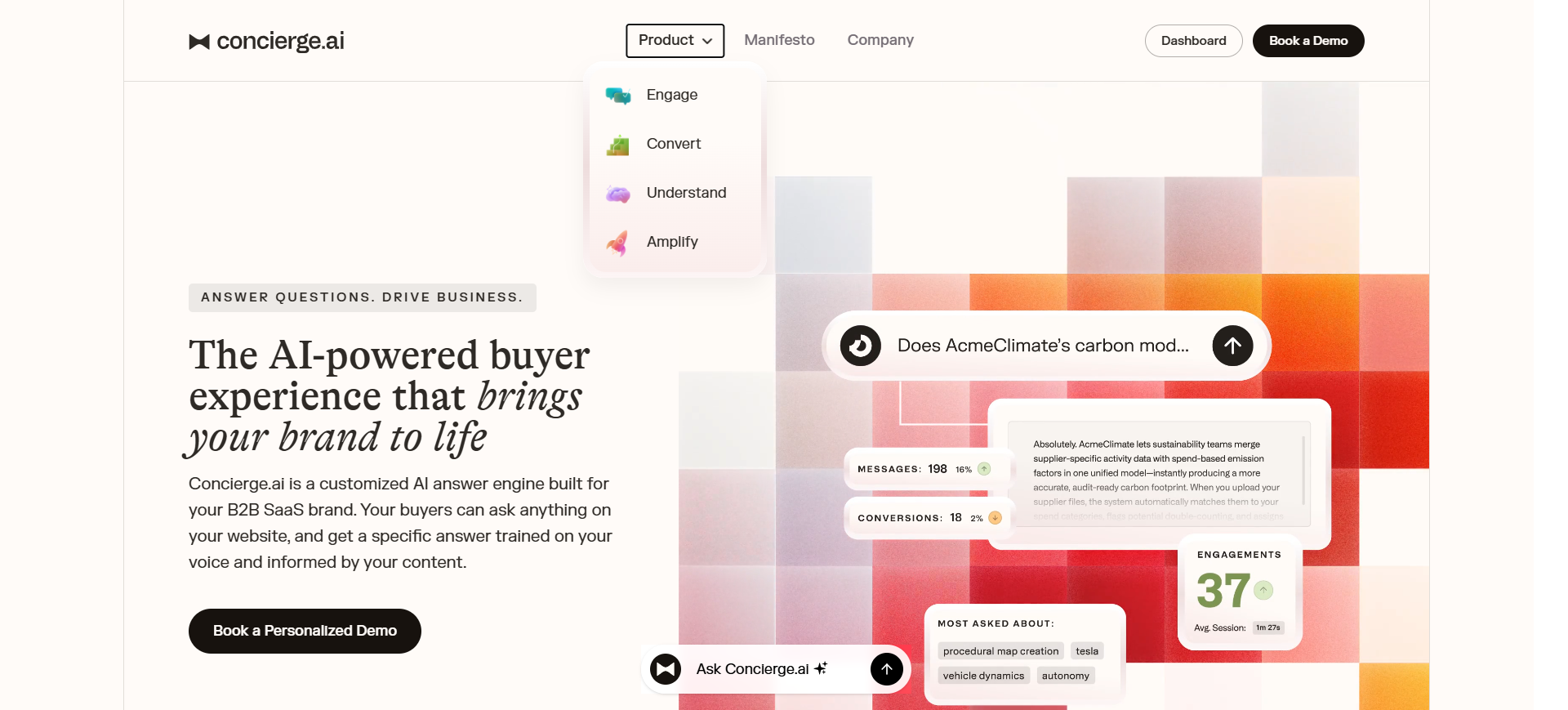
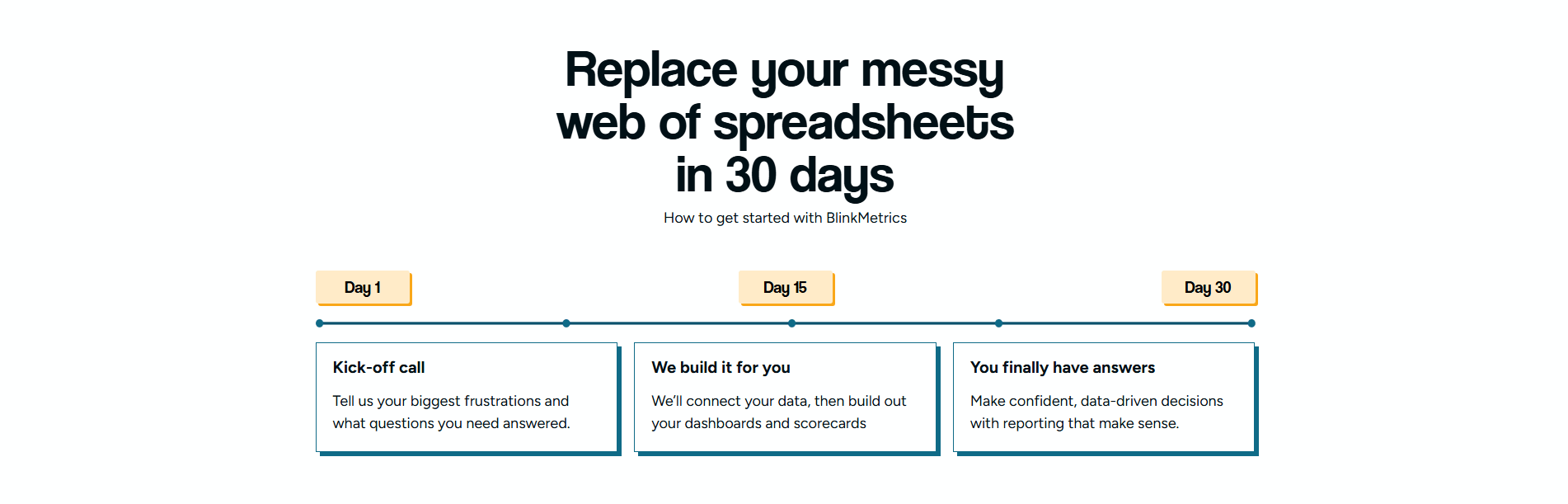
In this dataset, Use Cases tends to outperform at 89.8 while Comparison is the most fragile at 0, suggesting many marketing pages invest in headline messaging but leave gaps in navigation, use-case routing, and workflow explanation that slow decisions. Concierge AI's action-oriented navbar labels (Engage, Convert, Understand, Amplify) and BlinkMetrics' Day 1/15/30 timeline with done-for-you framing show how underused sections can do heavy conversion work. See how best fintech websites handle similar clarity gaps in adjacent categories.
If you are refreshing a marketing landing page design, treat these "unsexy" blocks as conversion infrastructure, not filler.
How does your marketing homepage compare?
Five quick questions to see where your page stands against this marketing benchmark. For a full section-by-section audit, try our landing page analyzer.
Interactive quiz
What would your marketing homepage score?
Question 1 of 5
0%
Can a marketing buyer identify your core outcome in under 5 seconds?
"Get 3x more demos from your landing pages" beats "the all-in-one marketing platform."
Reviewed by
Gabriel Amzallag — Founder, LPA
Worked on website and growth at scale-ups like Qonto, PayFit, and Pigment. After 5 years helping SaaS companies convert, I noticed the same homepage mistakes everywhere—so I built a benchmark to score what actually works across 60+ conversion criteria.
See how your page compares to the 53.6 marketing average
Run a section-by-section diagnostic on your marketing page and get prioritized fixes, then see how you stack up against these marketing website examples.
Benchmark-backed answers for marketing website design
FAQ: Best Marketing Websites (Marketing Benchmarks)
Quick answers to common questions about what makes the best marketing websites convert, based on section-level benchmark data from this review.
What are the best marketing websites?
[01]
Some of the strongest examples in this benchmark include Perspective, Comet Rocks, Rampmetrics, ZoomInfo, Beamly, and Whatagraph. We reviewed 84 marketing pages using the same conversion-focused rubric. See the full shortlist above for detailed takeaways.
What makes marketing websites harder to convert than other categories?
[02]
Marketing buyers already know the persuasion playbook, so generic promises feel hollow faster. In this benchmark, Use Cases sections averaged 89.8 while Comparison averaged 0, suggesting the gap is widest where pages fail to prove their claims with concrete product proof and measurable outcomes.
What is the biggest design mistake on marketing homepages?
[03]
Relying on category labels instead of specific outcomes. With an average page score of 53.6, many marketing pages describe what they are instead of what changes for the buyer, and they bury product proof below the fold where most visitors never see it.
What sections should a marketing homepage include?
[04]
A strong marketing homepage typically includes a clear hero with one primary action, an early trust layer (review badges, customer counts, integration logos), a visual product overview or workflow, use cases tied to measurable outcomes, and a low-friction CTA with supportive microcopy. In this benchmark, Cta, Hero, and Testimonial sections appeared most often in high-scoring pages.
How important is visual hierarchy for marketing website design?
[05]
Critical. The strongest pages guide the eye from headline to proof to CTA using contrast, whitespace, and typographic weight, so the visitor absorbs the argument without having to search for it. Layout clarity is the single most consistent differentiator between high- and low-performing marketing pages.
Where can I find great marketing website design inspiration?
Use a structured rubric that checks clarity, trust, and friction instead of relying on subjective feedback. Run your page through the landing page audit for a section-by-section score.